MICHA.ELMUELLER


University project: Route planner for the university terrain

At my university every bachelor student of a computer science degree has to do a project in a team. For one semester you plan the project, do requirements engineering, etc. in a team of 3 students. In the next semester you actually code the project in a team of 6 students.

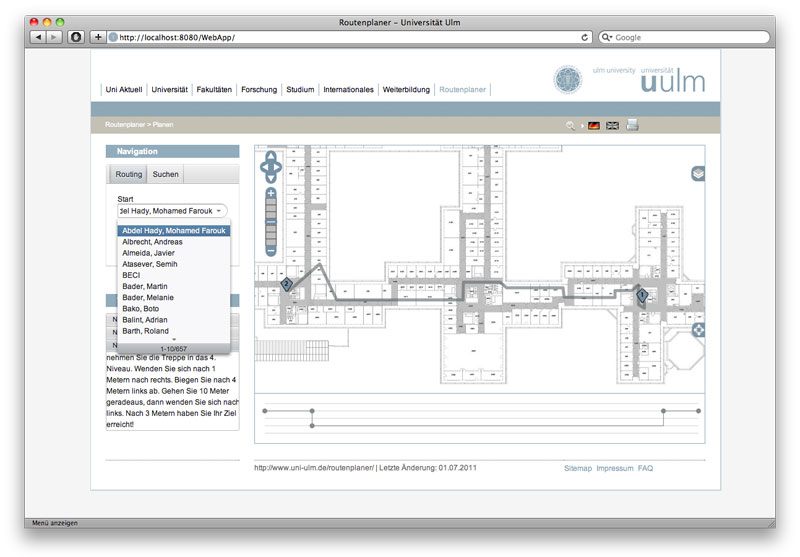
All teams had to implement the same project. The project was to build a route planner for the university terrain from ground up.
There were some things that were quite tricky: Things like multiple floors on top of each other.

About the routing: Usual algorithms for routing problems (Dijkstra, Bellman-Ford, etc.) take the approach of a weighted graph. Our team decided to go for a graph-based NoSQL database: Neo4J. Since we were going to build a route planner we might as well use a database that is inherently constructed using a graph.

Many of the other teams had problems with the routing algorithms.
If you were going to use some relational database, this was going to get quite ugly.

Don’t choose your technologies just because it is the only technology you happen to know! Choose the technologies based on the fact that it fits the job best.

As a web application framework we decided to go for Vaadin. Vaadin is a framework on top of GWT that enables you to write web applications like you would write a Swing application in Java. A cross-compiler converts Java code into JavaScript, HTML & CSS. Since most members of our team were familiar with Java, this was an easy choice. The framework worked quite well, very fast development cycle.

We also wrote a standalone desktop application for uploading and editing maps. But since we splitted the tasks I was only involved in the synchronization with the web app (which we did using git, see my article Git as an Update mechanism).

Other technologies involved: For printing PDFs we decided to go with LaTeX. We used node.js to scrape the university address book. This way we gathered a large amount of reasonable data for the database.

The student-projects will not be used productive. However the institute works on an example implementation that will be used.
 

Unsere Gesellschaft zerstört Kreativität.

Das Turbo-Abi macht unsere Kinder zu Lernrobotern – sie schaufeln den Stoff in sich hinein und spucken ihn für Noten wieder aus. […]

Wir müssen Fächer streichen und die Lehrpläne auf ein Mindestmaß reduzieren.
Notwendig ist das eigenständige Lernen in Projekten, in denen unsere Kinder die Kompetenz entwickeln,
die sie für die Zukunft brauchen: Teamfähigkeit und soziale Verantwortung statt Ellbogenmentalität,
Kreativität und Erschließen von Zusammenhängen statt Fachidiotie, Lernen aus Interesse statt Lernen für die nächste Note.

Ulrike Köllner, in der taz vom 20.8.11

Ich beobachte in meinem Studium häufig, dass Kommilitonen die Fähigkeit fehlt im engeren Sinne kreativ zu arbeiten: Sie können Dinge nicht hinterfragen oder aus verschiedenen Blickwinkeln betrachten.

Unser Gesellschaftssystem ist nicht darauf ausgelegt kreative Menschen zu fördern. Das System belohnt Querdenker nicht. In der Schule wird etwa der Schüler belohnt, der fremdes Gedankengut möglichst originalgetreu wiedergibt und niederschreibt. Nicht derjenige, der sich eigene Gedanken macht oder den Stoff hinterfragt.

Nikola Tesla studierte erst Mathematik, dann unter anderem Physik und Philosophie. Er studierte über Jahre hinweg an verschiedenen Universitäten und wurde zwischendurch sogar exmatrikuliert. Tesla gilt als einer der einflussreichsten Ingenieure unserer Geschichte. Wechselstrom oder Radiotechnik etwa sind seine Verdienste. Heute würde er vermutlich als Langzeitstudent abgestempelt werden. Ihm würden Vorwürfe gemacht werden, weil er nicht rechtzeitig fertig geworden ist, die Regelstudienzeit überschritten hat oder noch nicht in einer Firma arbeitet.

Würde er wohl mit solch einer Vergangenheit noch einen Studienkredit oder BAföG bekommen?

Große Wissenschaftler und Ingenieure waren oft vielfältig gebildet und auf mehreren Gebieten tätig. Oft musikalisch begabt und künstlerisch tätig. Als Schriftsteller oder Maler: Der erste Philosoph, Pythagoras, war auch einer der größten Mathematiker. Im Zuge der Industrialisierung im 20. Jahrhundert fand eine Spezialisierung der Berufe statt. Wer früher ein ganzes Auto bauen musste, muss jetzt nur noch drei Schrauben anziehen können.

Wenn ich heute Leuten erzähle, dass ich Vorlesungen höre, die ich nicht anrechnen lassen kann, können die meisten Gesprächspartner das nicht nachvollziehen. Es macht auf sie einen seltsamen Eindruck. Einige Kommilitonen von mir studieren inzwischen seit mehr als siebzehn Semestern. Ein anderer ist im neunten Bachelorsemester.

Wieso wird so etwas von einem nicht unbeträchtlichen Teil der Gesellschaft als seltsam und negativ angesehen?

In Diskussionen mit diesen Leuten habe ich immer den Eindruck, dass sie denken man würde die Gesellschaft aufhalten. Nicht zum Fortschritt beitragen. Faulenzen, nicht fleißig sein, nicht arbeiten. Den ganzen Tag irgendetwas machen, bloß nicht studieren. Meiner Ansicht nach ist diese Haltung enorm kurzsichtig! Für mich ist Studium genau das: Seine eigenen Interessen verfolgen, herausfinden was einen interessiert, fachfremde Vorlesungen hören, seinen Horizont erweitern, sich mit etwas auseinanderzusetzen ohne ein direktes kommerzielles Interesse zu verfolgen!
Letzlich ist Innovation eben nicht von jemandem zu erwarten, der nur das Nötigste lernt und das Studium überhaupt eigentlich nur hinter sich bringen will, weil er später mal ein Einkommen benötigt.

Unser Bildungssystem ist nicht darauf ausgelegt fähige Wissenschaftler, die selber nachdenken, hervorzubringen sondern Arbeitskräfte für die Wirtschaft, die nur das Nötigste zu wissen brauchen.

Dann wird eben nur gepaukt und nicht studiert.

Wieso fällt es vielen Leuten extrem schwer Dinge nicht nur herzustellen und zu kopieren, sondern komplett neu zu entwerfen. Sich neue Architekturen und Ansätze zu überlegen. Bestehendes über den Haufen zu werfen und einen komplett neuen Ansatz zu schaffen?

Weil sie es nie gelernt haben.


Flyer des Bildungsprotests, entdeckt an der Uni Ulm.
Ich finde ihn sehr passend zu diesem Beitrag.


Chaos Communication Camp 2011

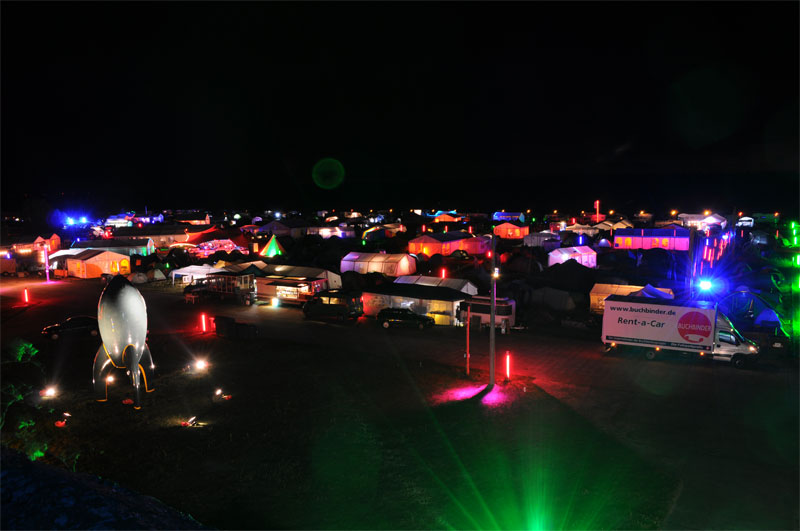
The CCCamp repeats every four years. It is organized by the german Chaos Computer Club and is basically a big get-together for Hackers from all around the world. The camp is placed in the german city Finowfurt, near Berlin. The Camp itself is on an old Sowjet airport. Lectures are held in the hangars and on the whole camping side you can find old airplanes. Pretty cool atmosphere!

I attended the camp with some friends and had an amazing time. I met many interesting people, attended a hell lot of talks. Did some very interesting workshops and learned a lot new stuff. Probably one of the better weeks :-).

Best talk: OpenLeaks
What to say? I think they are doing a great job, from seeing the stuff and talking to the people behind the platform I have a very good impression. Technically very competent people. Friendly and honest.

It makes me angry to see people talk them down! I was critical in some points and so I went to their tent and talked to them! This is why you go to such a camp! If you talk to people you get new insights and different points of view. In the end this helps you to make up your own judicious opinion.

How I see it, the exclusion of Daniel Domscheit-Berg from the CCC was clearly a mistake. Unrational, childish and in rage. This is an absolutely unacceptable behaviour for a club that advises our government in security issues.

Best workshop: Live Coding with Fluxus
(fluxus) is a framework for Live Coding. It uses OpenGL as a Backend and Scheme as a programming language. The workshop focused on the performance of a VJ and was very interesting. Within 2 or 3 hours cupe_cupe developed a pretty impressive music visualization. There was also a DJane at the workshop who did the music for the visualization 🙂 . This is how a workshop should be!

For the awesome photos below I have to give credit to Seder.
You can download the High Resolution pics from his deviantART page.

We also used a soup for the time during the camp. There are some more photos we took.

Update: Best radio summary I found: 1 live Reportage (WDR) (Audio, Laufzeit 37:56)


The UNIX-Philosophy

I wrote an article on the UNIX philosohpy for the blog ioexception.de (in german).

The article explains some of the concepts behind modern unix-like operating systems like GNU/Linux, Mac OS X, *BSD or Solaris. These concepts are not limited to operating systems, but extend to a general style of developing and working on projects.

UNIX was developed specifically for experts. For people who know what they do and what they want.

UNIX-Typografie

About Me

I am a 32 year old techno-creative enthusiast who lives and works in Berlin. In a previous life I studied computer science (more specifically Media Informatics) at the Ulm University in Germany.

I care about exploring ideas and developing new things. I like creating great stuff that I am passionate about.

License

All content is licensed under CC-BY 4.0 International (if not explicitly noted otherwise).
 
I would be happy to hear if my work gets used! Just drop me a mail.
 
The CC license above applies to all content on this site created by me. It does not apply to linked and sourced material.
 
http://www.mymailproject.de